Communications strategy · Research · Decision support
Making complex challenges clear enough to act on.
I help organizations understand and connect to their audiences, identify the right problems to solve, and make the path forward clear and actionable.
My experience spans national campaigns, executive consulting, and hands-on operational analysis. The common thread is an insatiable curiosity, a joy of diving into the details, and an ability to articulate a clear case for what comes next.
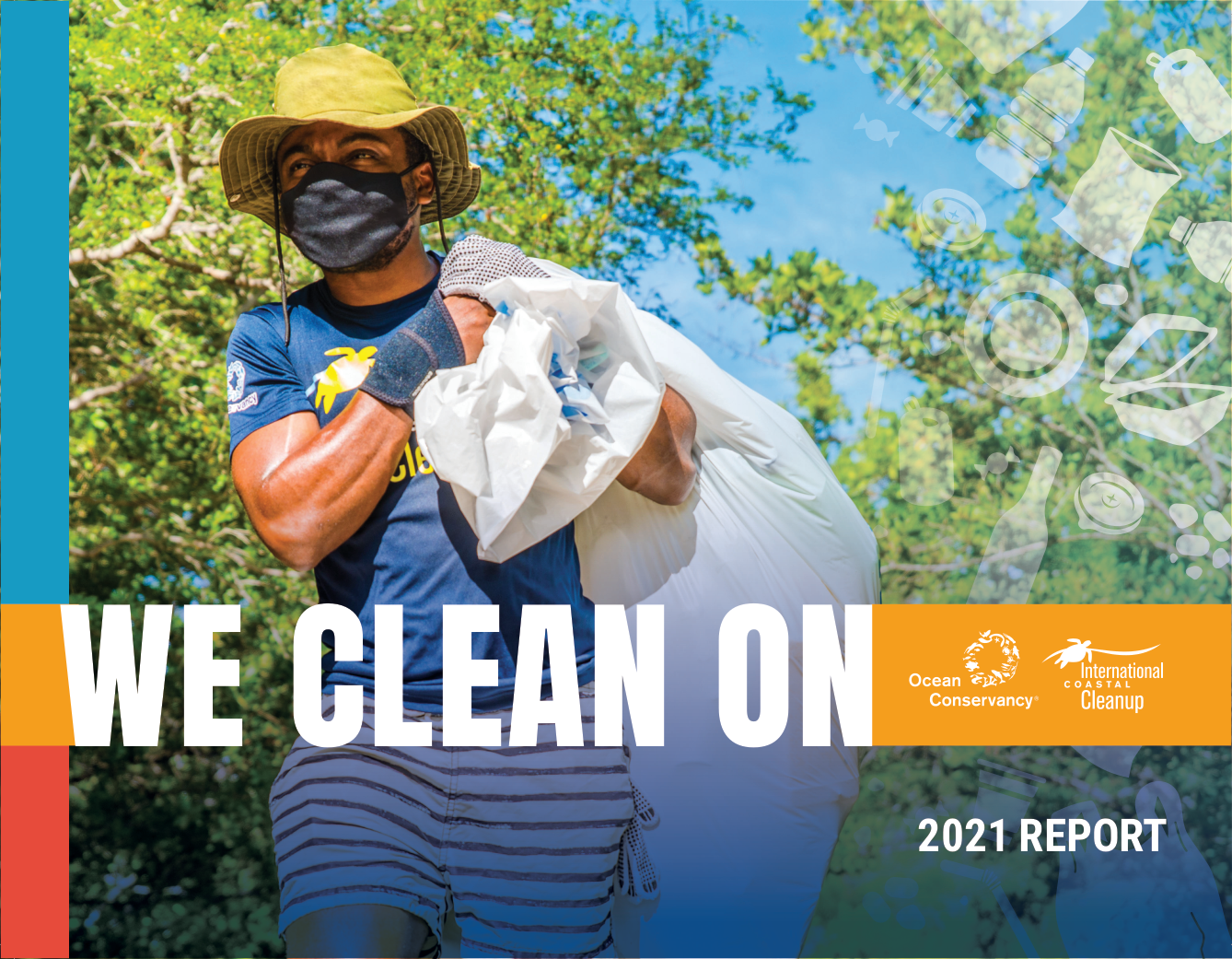
Ocean Conservancy · International Coastal Cleanup 2021 report on 2020 cleanup activity Writing and creative direction · Co-managing editor Design: Blue House Design
A public report that brings participant stories, scientific context, and extensive cleanup data into one coherent account of a global effort.
The communication challenge
COVID-19 disrupted the large community events at the heart of the 2020 International Coastal Cleanup. The report presents how coordinators and volunteers adapted, while putting the significance of their work and the data they collected into perspective.
My contribution
I wrote the report and directed the creative work, serving as a credited co-managing editor alongside Madeline Black of Ocean Conservancy. Blue House Design created the design with direction from the editorial team. The collaboration connected human stories and detailed data in a compelling narrative.
Editorial and creative approach
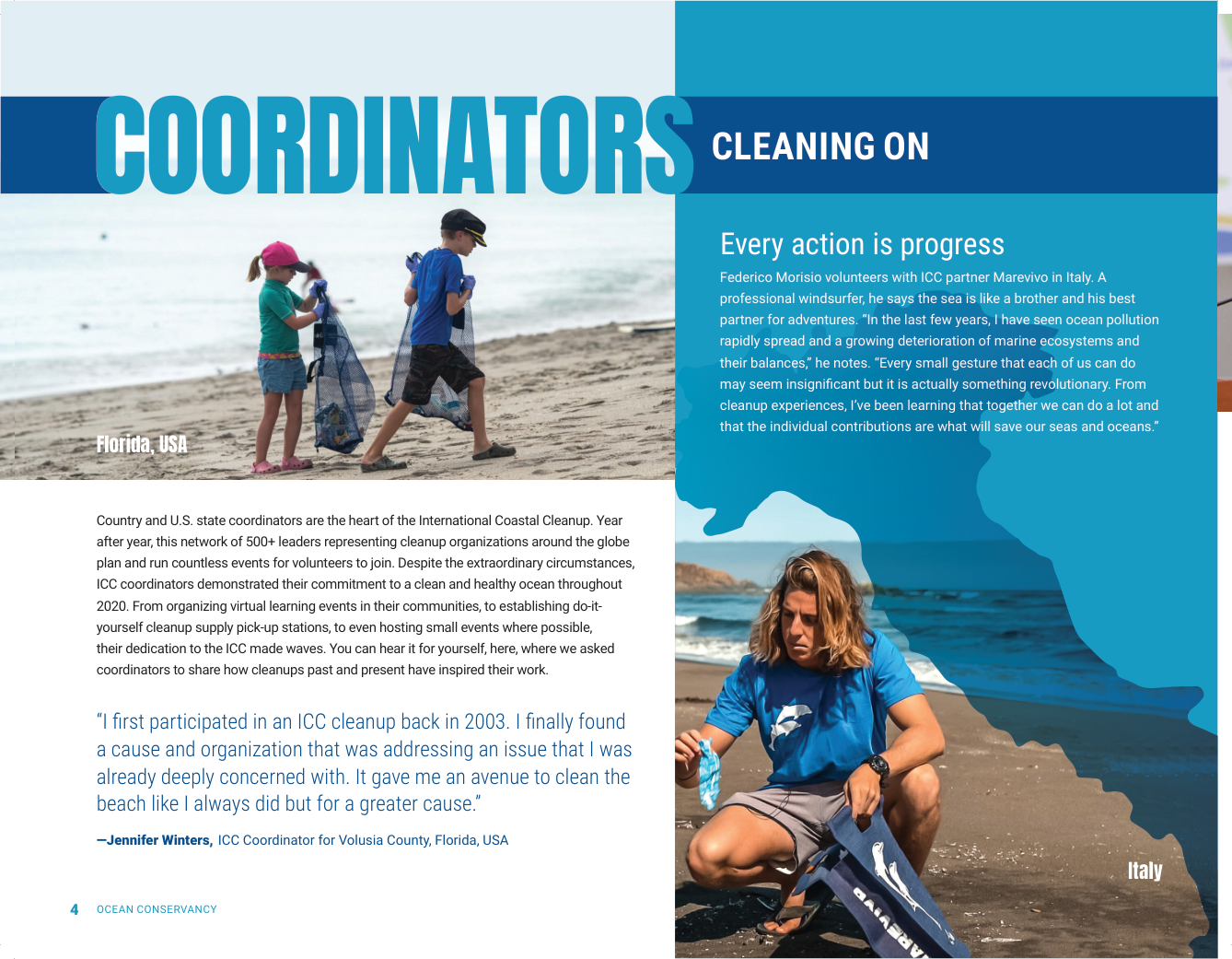
The report connects individual contributions to global scale, giving readers both people to recognize and evidence to understand.
An existing report theme that carries through the publication.Participant stories ground the work in specific people and places.
Turning data into a story
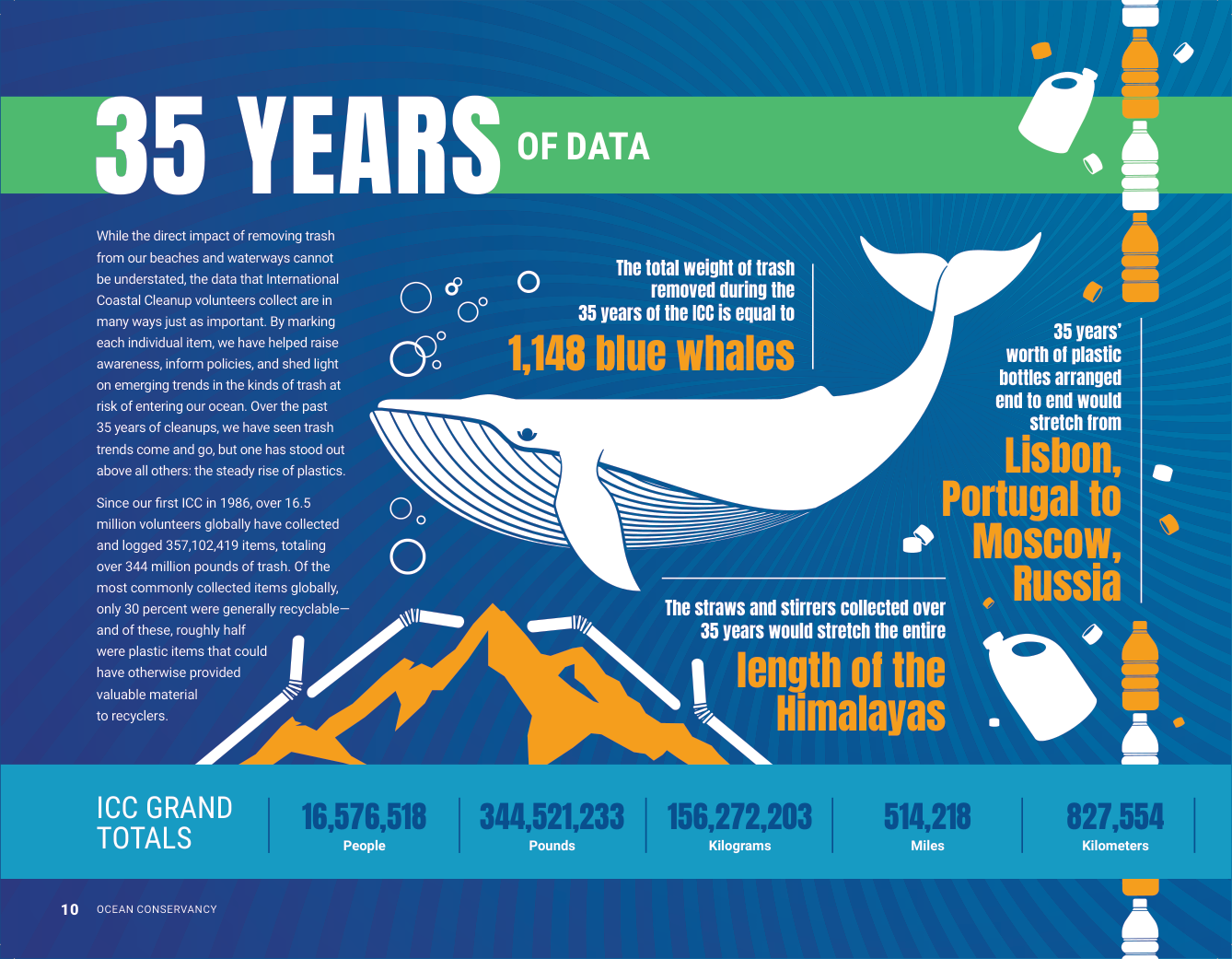
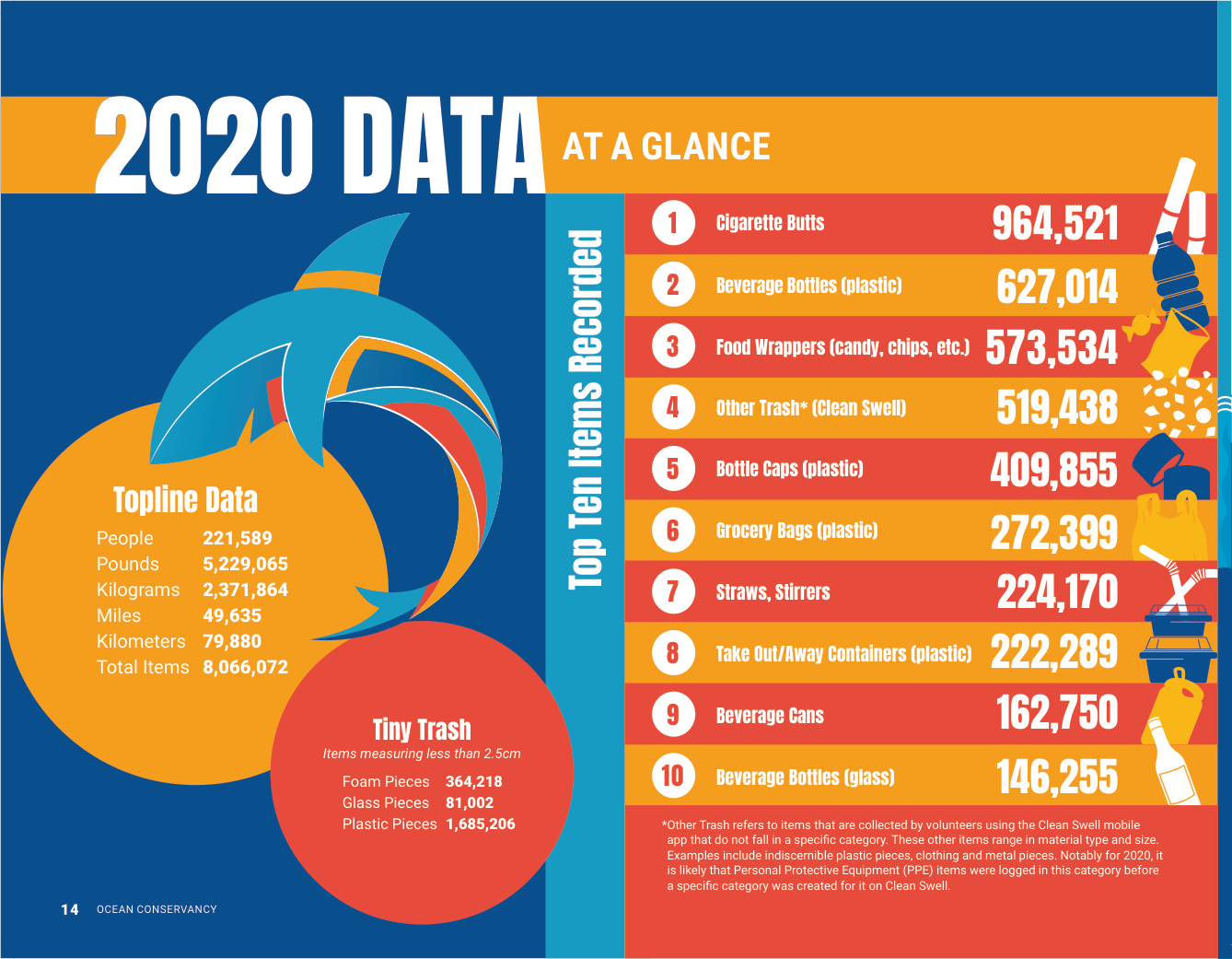
Illustrated comparisons make large cumulative totals easier to grasp. The report moves from those accessible entry points to annual summaries and detailed country and state indexes, giving readers multiple levels of information.
Keeping the evidence clear
The publication distinguishes annual cleanup activity from 35-year cumulative figures and gives emerging PPE pollution its own explanation. These are results of the cleanup program and related research, rather than measures of the report’s communications impact.
Making cumulative scale understandable · printed page 10.Organizing a dense annual data story · printed page 14.
What this work demonstrates
Writing, editorial synthesis, creative direction, and collaboration with designers on a finished public-facing publication. The report credits my managing-editor role on printed page 28. Communications performance data is not available for this case.
A retrospective brief for this case
This framing was reconstructed from the finished work in 2026. It is not an original project brief. The audience priority and intended response below are interpretations for portfolio discussion.
Audience: Ocean Conservancy donors, cleanup coordinators, volunteers, partner organizations, and media, with public readers as additional audiences.
Communication objective: help readers understand the scope and value of the annual event, even during a pandemic, recognize local leadership, and connect that work to a wider effort.
Creative rationale: lead with people, make scale tangible through illustrated comparisons, and retain detailed evidence for readers who want to examine the data.
02 / Research and outreach strategy
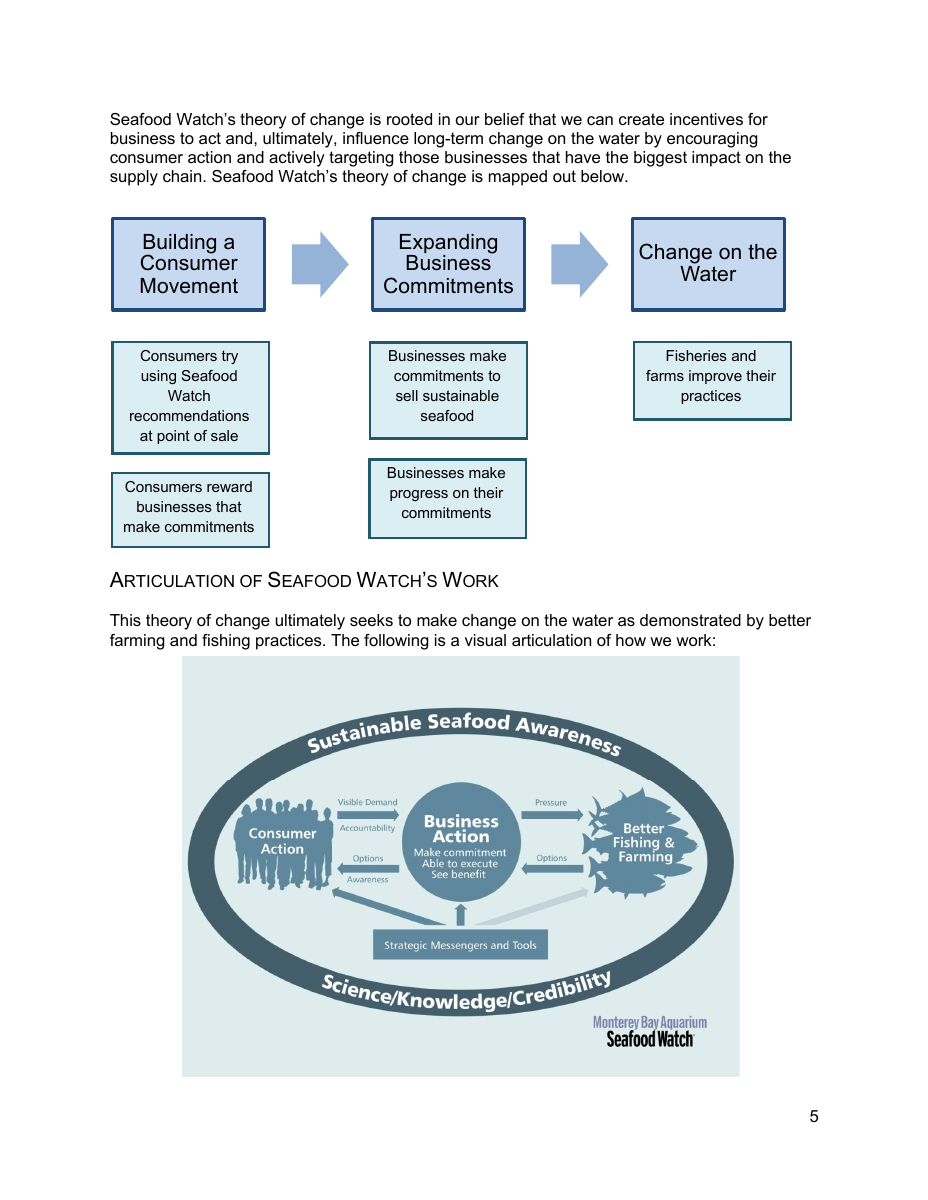
Connecting consumer action to change on the water.
Monterey Bay Aquarium Seafood Watch Spitfire Strategies · 2013 Strategic realignment and outreach planning
A respected science program needed a shared explanation of how its consumer, business, and science work are collectively driving demand for sustainable seafood.
The challenge
The materials review identified inconsistent descriptions of the program’s mission and plans that blurred goals, strategies, and activities. Staff interviews surfaced strong program-level thinking, but a less consistent account of how the parts supported the whole.
The research
The engagement brought together existing strategic plans, consumer and business research, and staff interviews. I led the strategic realignment, integrating that evidence into a theory of change, audience priorities, and an outreach framework.
The strategic decision
Make the first action easier: help more consumers ask about sustainable seafood, creating visible demand that gives businesses a reason to act.
Two audiences. Different jobs.
People ready to try
Research suggested the existing green audience had limited room for growth. The plan prioritized a larger group likely to try the recommendations and influence others.
Implication: simple tools, accessible messages, and a manageable question at the point of sale.
People already engaged
Existing users remained essential for reinforcing demand and holding businesses accountable to their commitments.
Implication: access to more detailed information and specific opportunities to recognize or question business practices.
A shared message platform
The strategy organized the program story around audiences’ shared values, addressed their barriers, gave them a simple action, and described the future payoff of their action. Messages were tailored for specific audiences.
Direction for execution
Recommendations included simplifying the pocket guide, tailoring website pathways, equipping outreach partners, and streamlining business support. These choices gave communications and digital teams a common direction.
What this work demonstrates
Research synthesis, audience prioritization, message architecture, and a clear connection between communications and business behavior. The source establishes a strategic blueprint; it does not establish achieved campaign results.
View an original strategy page and project scopeOriginal strategic output · August 2013 · page 5. Historical program strategy.
The August 2013 outreach strategy documents the diagnosis on pages 3–4, theory of change on pages 4–7, message platform on pages 8–9, audience decisions on pages 11–15, proposed measurement on pages 16–18, and execution recommendations on pages 24–28.
Portfolio account based on the original strategy and my career record. The document’s future targets are planning measures, not reported outcomes. This summary does not claim authorship of the client’s existing science, consumer research, or finished creative.
03 / B2B technology and communications strategy
Making industrial technology make sense.
Machfu · Industrial Internet of Things Sole communications consultant over several years Messaging, content strategy, writing, and website development
Helping a technology company explain what its products could do, why those capabilities mattered, and how to tell that story to different audiences.
The communication challenge
Machfu’s gateways connected industrial equipment and existing systems with custom applications and cloud services. Explaining the technology meant getting the technical details right while helping audiences understand the practical value for their business.
My contribution
As Machfu’s sole communications consultant for several years, I worked with its CEO and product development team to translate features and capabilities into audience-specific messages. My work spanned technical briefs, media outreach, LinkedIn engagement, the content and build of two websites, and an explainer video for sales outreach.
A central messaging choice
Show what connected equipment makes possible: useful information, better decisions, and more value from systems customers already have.
Translate without losing the meaning
I worked through technical input with leadership, deciding what needed explanation and what could be simplified. In the video script, that included describing the value of connecting existing systems without suggesting customers needed to replace the infrastructure they had invested in.
Give each format a job
A technical brief could carry more detail. The website needed to make the offering understandable and help visitors find relevant applications. The video gave us a short, accessible way to introduce the product and open a sales conversation.
Featured creative work · 2019
A technical story, written for animation.
I wrote the sales video script and worked with Heming Nelson and his team at 4Site Interactive Studios as they developed the animation. The script connected industrial equipment, data, and business benefits in a short narrative, with language designed to accommodate other industrial applications.
During development, I revised the narration, incorporated technical feedback, and reviewed on-screen benefit statements. Heming’s team handled visual development, animation, voiceover, and production.
The Brand Strategy Roadmap explored a shift from operating-system positioning toward industrial performance and ESG. It brought vision, purpose, values, a central brand idea, and strategic priorities together in one concise document.
Brand idea
“Machfu delivers better industrial performance on the journey to net zero.”
Customer promise
“Get data-driven performance while reducing your climate impact.”
The positioning questions
How could Machfu define its offer for ESG audiences, distinguish itself from other management systems, and support customer growth?
A direction for action
Make the business case through ROI, connect the offer to net zero, and explore partnerships with climate advocates.
Selected excerpts and summary from the original Brand Strategy Roadmap, September 2022. This was a proposed positioning direction; the environmental benefits and growth ambitions are not presented as verified outcomes. It was developed several years after the featured video.
Website work and supporting process
I developed the content and managed the build of two Machfu websites. I was responsible for messaging, content, and project management, with Prakash responsible for approval and a developer responsible for design and development. It prioritizes plant and facility managers who are not IT experts as the primary audience.
Website specifications, content drafts, script versions, and production correspondence document the work. The original website visuals are not reproduced here.
What this work demonstrates
B2B positioning, technical translation, audience-specific writing, and collaboration with a creative production team. The examples show strategic outputs and completed communications work; campaign performance and sales attribution are not available for this case.
04 / Research and organizational strategy
Turning employee interviews into an engagement and retention strategy.
A healthcare organization needed to understand what high-performing leaders from underrepresented groups valued and how to strengthen their engagement.
Diversity Works · 2022 Qualitative analysis and strategic recommendations Client anonymized for this portfolio
My contribution
The client conducted the interviews. I analyzed the interview material, organized responses into a coded database, and compared patterns across questions and audience groups. The work combined qualitative interpretation with quantitative summaries.
From findings to action
The analysis produced motivation-based personas and a framework for understanding development needs. Recommendations called for sharing findings with participants and leaders, validating the interpretation, and involving participants in shaping the response.
A decision the research informed
Build the response with the people it is meant to serve. Validation and participation belong inside the strategy.
Research judgment
The original report is confidential. This account describes the analytical method and strategic process without reproducing employee quotations, demographic comparisons, compensation findings, or client data. The client reported a measured retention improvement after implementing the recommendations in the report.
05 / Recent analytical practice
Building tools around operational decisions.
Peak capacity planning
Built an Excel Power Query model combining warehouse inventory, forward-pick capacity, reserve inventory, and peak demand forecasts into a SKU-level view. The model helps identify where available picking capacity may be insufficient for projected demand.
Inventory lookup applications
Developed and deployed multiple Streamlit applications in Snowflake: a pending-order SKU lookup, a lost-inventory investigation tool, a carrier-status query, and others. Each turns a recurring investigation into a more accessible decision workflow.
Chewy · Reno · Operational analysis and tool development. Descriptions summarize the work without exposing internal data or application access.
How I work
Follow the evidence. Make the path forward clear.
Understand
Clarify the business problem and listen to the people closest to it.
Investigate
Compare research, stakeholder perspectives, and available data.
Choose
Identify the audience, the barrier, and the action most likely to matter.
Equip
Translate the strategy into messages, briefs, tools, and dashboards.
About Elizabeth
A strategist with a builder’s curiosity.
I bring more than 20 years of strategic communications and consulting experience, including founding and leading Diversity Works and senior roles at Spitfire Strategies, FINN Partners, and APCO Worldwide.
My recent work at Chewy adds a close understanding of operational complexity, data modeling, and app development to that communications foundation.
Based in Reno, Nevada. UCLA BA in Geography and Environmental Studies. Cornell Certificate in Diversity and Inclusion.